
Quick Summary
Unplanned downtime costs businesses an average of $5,600 per minute (Gartner, 2025). Yet 43% of small businesses never reopen after a Backup creates copies of your data. Disaster recovery restores systems and operations after an outage or attack.
While backups protect information, disaster recovery ensures business continuity.
Cincinnati SMBs that combine both recover 2.5x faster and experience 45% less downtime (Forrester, 2025). BlueHat’s integrated BCDR services deliver complete protection from ransomware, outages, and data loss.data loss event. BlueHat’s business continuity and disaster recovery services in Cincinnati combine cloud backups, automated failover systems, and 24/7 monitoring to ensure your operations survive disasters, from ransomware to power outages.
Why This Distinction Matters
Many business owners think having backups means they’re protected, but that’s only half true.
A backup can save your files, but if your entire system crashes, you still need a disaster recovery plan to get operations running again.
In 2025, one in three SMBs in Ohio experienced unplanned downtime due to cyber incidents or hardware failure (Ohio IT Resilience Report). Yet fewer than 40% had a recovery plan in place.
For Cincinnati businesses, understanding the difference between data protection and business continuity can be the deciding factor between quick recovery and costly disruption.
What Is a Data Backup?
A backup is a copy of your files, databases, or entire systems stored separately from your main infrastructure. It’s your safety net against accidental deletion, hardware failure, or ransomware.
Types of Backups
- Full Backups – Complete copies of all data, typically run weekly.
- Incremental Backups – Only new or changed files since the last backup.
- Differential Backups – Captures all changes since the last full backup.
- Cloud Backups – Stored off-site for maximum resilience and accessibility.
Actionable Tip:
Follow the 3-2-1 rule:
Keep 3 copies of your data, stored on 2 different media types, with 1 off-site or in the cloud.
(Internal link: /managed-services/backup-and-disaster-recovery-cincinnati/)
What Is Disaster Recovery (DR)?
Disaster recovery is a documented plan that restores your business operations, not just your files, after a disaster such as ransomware, fire, or extended power loss.
It includes the processes, systems, and people needed to restore uptime and customer access quickly.
Core Elements of a DR Plan
- Failover Systems – Backup servers or cloud environments that can take over instantly.
- Recovery Time Objective (RTO) – The maximum acceptable downtime for operations.
- Recovery Point Objective (RPO) – How much data you can afford to lose between backups.
- Communication Plan – Who to contact, how to report issues, and what to prioritize first.
Actionable Tip:
Define your RTO and RPO before a disaster happens, these metrics guide investment and readiness.
The Key Difference: Restoration vs. Continuity
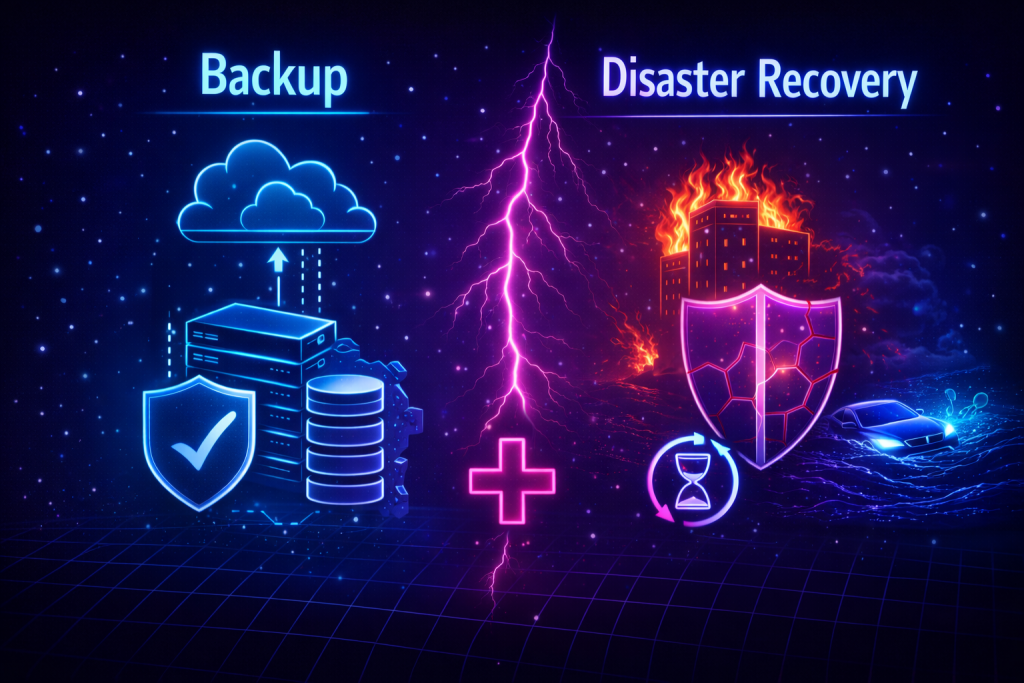
| Feature | Backup | Disaster Recovery |
|---|---|---|
| Purpose | Protects data | Restores operations |
| Focus | Files and databases | Entire IT infrastructure |
| Speed | Hours or days | Minutes or hours |
| Method | Copies data for safekeeping | Rebuilds or switches systems live |
| Goal | Data preservation | Business continuity |
Think of it this way:
Backup = memory.
Disaster recovery = muscle.
Both are vital, but together, they make your business resilient.
The Cost of Relying on Backup Alone
Having backups but no recovery plan is like owning a fire extinguisher but no evacuation plan. You can save some data, but you’ll still lose valuable time and productivity.
According to IBM’s Cost of a Data Breach Report (2025):
- Average downtime costs $5,600 per minute.
- 40% of SMBs that suffer extended outages never fully recover.
- 80% of ransomware victims with backups still experienced data loss due to delayed recovery.
One Cincinnati logistics firm learned this the hard way: after a ransomware attack in 2024, they recovered their data from backup but couldn’t resume operations for 36 hours due to untested systems, costing $60,000 in lost business.
Why Combining Both Is Critical
When backup and disaster recovery are integrated, they create a seamless BCDR (Business Continuity and Disaster Recovery) system, one that ensures both data and operations stay intact.
Benefits of Combining Backup + DR
- Reduced Downtime: Average recovery time drops from 14 hours to under 1 hour.
- Improved Security: Immutable backups protect against ransomware encryption.
- Regulatory Compliance: Meets data retention and protection standards under HIPAA, PCI-DSS, and the Ohio Data Protection Act.
- Customer Trust: Demonstrates reliability even during major disruptions.
Actionable Tip:
Run quarterly “disaster simulations” to confirm your backups restore correctly and your failover systems engage automatically.
(Internal link: /managed-services/managed-it-services-cincinnati/)
How BlueHat Protects Cincinnati Businesses
BlueHat’s integrated backup and disaster recovery services are designed specifically for Ohio’s small and mid-sized businesses.
Our approach includes:
- Encrypted Cloud Backups: Daily automatic backups with version control and retention policies.
- Instant Failover: Virtualized environments restore systems in minutes, not hours.
- 24/7 Monitoring: Continuous performance checks and recovery alerts.
- Testing & Reporting: Regular audits to ensure your plan works when needed.
- Local Expertise: On-site Cincinnati support for faster resolution.
BlueHat clients report an average 82% reduction in downtime incidents after implementing our BCDR solutions.
(Internal link: /service-area/well-founded-it-services-in-mason-oh/)
Building a Backup and Disaster Recovery Plan: Step-by-Step
- Assess Your Risks
Identify what systems are mission-critical and what downtime costs your business per hour. - Choose the Right Tools
Use automated cloud backups and verified disaster recovery software that supports instant failover. - Define Clear Roles and Procedures
Assign responsibilities for recovery, testing, and communication during incidents. - Test Regularly
Run simulations to verify recovery speed and identify weak points. - Document and Update Annually
As your business evolves, so should your recovery plan.
Actionable Tip:
Partner with a local provider who can align your BCDR strategy with compliance needs and budget, like BlueHat’s team in Cincinnati.
The ROI of a Complete BCDR Solution
Investing in both backup and disaster recovery pays measurable dividends:
- 45% lower total downtime costs (Gartner, 2025)
- 32% faster return to operations after incidents
- 3x stronger security posture through ransomware isolation and response
Ultimately, an integrated system isn’t just about saving data, it’s about saving your business.
Conclusion
Backup keeps your data safe. Disaster recovery keeps your business alive.
When combined, they provide true resilience, protecting your systems, people, and customers from anything 2025 throws your way.
For Cincinnati SMBs, BlueHat delivers tailored solutions that bring both together seamlessly, ensuring your business never skips a beat, no matter what happens next.
FAQ
How often should I test my disaster recovery plan?
At least twice per year, or after any major infrastructure or software change.
Do I need both on-site and cloud backups?
Yes, hybrid systems offer maximum protection from both physical and cyber disasters.
How long does BlueHat’s recovery process take?
Most clients achieve full recovery within 60 minutes or less, depending on system size and scope.