
Quick Summary
Unplanned downtime costs businesses an average of $5,600 per minute (Gartner, 2025). Yet 43% of small businesses never reopen after a major data loss event. BlueHat’s business continuity and disaster recovery services in Cincinnati combine cloud backups, automated failover systems, and 24/7 monitoring to ensure your operations survive disasters, from ransomware to power outages.
Why Business Continuity Matters More Than Ever
Cincinnati’s small and mid-sized businesses face unique risks: unpredictable Midwest weather, aging infrastructure, and rising cyberattacks. Whether it’s a flood, power outage, or ransomware incident, a single disruption can derail operations for days, or permanently.
Business continuity and disaster recovery (BCDR) planning isn’t just an IT concern; it’s a core business strategy. It ensures your organization can maintain critical operations and recover data quickly when the unexpected happens.
Without a plan in place, the consequences are severe:
- Lost customer trust and revenue
- Legal or regulatory fines
- Permanent data loss
- Damaged reputation that takes years to rebuild
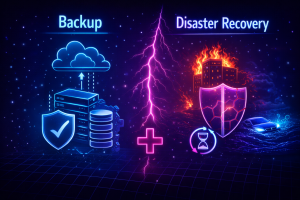
Business Continuity vs. Disaster Recovery: What’s the Difference?
Though often used interchangeably, they serve different, yet complementary, purposes.
- Business Continuity (BC): Keeps essential operations running during and immediately after a disruption.
- Disaster Recovery (DR): Focuses on restoring IT systems and data after the disruption ends.
An effective strategy blends both: continuity keeps you operating; recovery gets you back to normal.
(Internal link: /managed-services/backup-and-disaster-recovery-cincinnati/)
The Real Cost of Downtime
For SMBs, even short outages can have devastating financial and operational consequences.
According to IBM’s Cost of a Data Breach Report (2025):
- The average downtime cost is $9,000 per minute for mid-sized businesses.
- The average ransomware incident costs $1.82 million, including lost productivity and recovery efforts.
- 40% of companies without a BCDR plan never fully recover after a cyberattack.
For Cincinnati companies that rely on digital tools like CRMs, inventory systems, and payment portals, downtime doesn’t just mean lost revenue, it means losing customers who expect reliability.
Top Threats Facing Cincinnati Businesses
- Ransomware & Cyberattacks
Ohio saw a 37% increase in ransomware incidents in 2024 (Ohio Cybersecurity Center). Attackers now target SMBs through email phishing and network vulnerabilities. - Severe Weather Events
From ice storms to spring floods, Cincinnati’s climate can cause extended power and connectivity outages that cripple local operations. - Hardware Failure
Aging infrastructure and unmonitored storage systems still cause nearly 45% of data loss incidents (CompTIA, 2025). - Human Error
Accidental deletion or misconfigured settings are responsible for 22% of business data loss (Veeam Data Protection Trends Report, 2025).
Key Components of a Reliable BCDR Strategy
A modern business continuity and disaster recovery plan should cover these six areas to minimize downtime and protect your data.
1. Automated Cloud Backups
Daily encrypted backups stored off-site ensure your data remains safe, even if your physical systems are compromised. BlueHat leverages immutable storage technology, meaning backups can’t be altered or deleted, even by ransomware.
Actionable Tip:
Schedule backups to occur multiple times per day for critical systems, and verify recoverability monthly.
2. Rapid System Failover
Failover systems automatically switch operations to backup servers or environments when your primary system fails, minimizing downtime from hours to minutes.
Actionable Tip:
Implement virtualized infrastructure that allows instant recovery of essential applications, even remotely.
3. Regular Testing and Simulation
A BCDR plan is only as good as its last test. Annual simulations help ensure your data restoration and recovery times meet your business objectives.
Actionable Tip:
Perform a quarterly recovery test and document your RTO (Recovery Time Objective) and RPO (Recovery Point Objective), two critical metrics that define how quickly and how much data you can recover.
4. Cybersecurity Integration
Business continuity is incomplete without cybersecurity. BlueHat integrates 24/7 monitoring, threat detection, and ransomware prevention into every BCDR solution.
Actionable Tip:
Use endpoint monitoring tools to detect suspicious file encryption early, before ransomware spreads.
5. Employee Awareness and Training
Human error remains the leading cause of avoidable data loss. Every employee should know how to respond to incidents.
Actionable Tip:
Create a clear communication plan that defines who to contact, what systems to shut down, and how to report suspicious activity.
6. Vendor and Supply Chain Continuity
If your vendors can’t deliver during a crisis, your business suffers. Include suppliers in your BCDR assessments to ensure mutual resilience.
Actionable Tip:
Request your vendors’ continuity policies and ensure they meet your uptime and data protection standards.
The ROI of a BCDR Plan
Disaster recovery isn’t just an expense, it’s an investment in operational resilience. Businesses with a tested BCDR strategy recover 2.5 times faster than those without one (Forrester, 2025).
The financial benefits are clear:
- 45% lower total cost of downtime
- 32% faster return to full productivity
- 60% fewer compliance violations due to data protection improvements
Action Plan: How to Build a Resilient Continuity Strategy
- Assess Critical Systems
Identify which data, systems, and departments are essential to ongoing operations. - Develop Backup and Failover Policies
Set clear schedules for backups, recovery procedures, and responsible personnel. - Choose a Trusted Partner
Work with a local provider like BlueHat for on-site assessments, disaster recovery testing, and compliance audits. - Document and Test Regularly
Update your plan annually to adapt to new threats or business changes. - Train and Communicate
Ensure every employee knows their role in keeping the business operational during disruptions.
Conclusion
Disruptions are inevitable, but data loss doesn’t have to be. With a comprehensive business continuity and disaster recovery plan, your Cincinnati business can weather anything: cyberattacks, power outages, or natural disasters.
BlueHat’s locally managed BCDR services protect your data, your customers, and your reputation, ensuring your business remains secure, compliant, and confident no matter what 2025 brings.
FAQ
How often should a business test its BCDR plan?
At least once per year, though quarterly testing is recommended for critical systems.
Can BlueHat help with compliance?
Yes, BlueHat aligns BCDR plans with frameworks such as HIPAA, PCI-DSS, and NIST